

Social and Emotional Competence in Early Years Learners
Dr. Sonali Malhotra
Introduction
In today’s fast-evolving world, advocating for humanistic values such as empathy , inclusivity and sustainability in education is more crucial than before. For example, the increase in children’s screen time has reduced in-person interactions and non-technology playtime, emphasizing the importance of promoting empathy and teamwork in educational environments (Ho, et al. 2024). These values potentially ensure that every child has opportunities to thrive, realise their potential, and lead meaningful lives. Fairness in education relies on promoting empathy, respect, and acknowledging the intrinsic value of each person. This viewpoint is critical in promoting inclusive education, as supported by UNESCO (1994) and confirmed by Almalky and Alrabiah (2024) and Taneja-Johansson et al. (2023), who highlight the importance of establishing educational settings that bring happiness and satisfaction to all children, regardless of their skills or backgrounds. Yet, conventional education systems, influenced by the demands of the fourth industrial revolution, frequently prioritize memorization and gaining knowledge over fostering vital life skills.
Research, such as Howe’s (2013), reveals that empathy—a natural human trait—can diminish over time due to technological distractions, an increased focus on self-interest, and the lack of effective role models. Garnett (2017) agrees educators face a challenge due to this erosion, particularly in today’s quickly changing technological world. According to Coskun (2019), children have a natural ability to understand the emotions of others, offering educators a special chance to promote social and emotional intelligence. Rahmi and Kristiawan (2024) emphasize the importance of the early childhood period as being crucial for children’s development, whereas Spagnuolo (2023) stresses the ethical duty of teachers to offer a comprehensive educational journey. Through the combination of play-based methods and Social-Emotional Learning (SEL), educators can tackle this challenge and promote the overall growth of children. In the face of these obstacles, Social-Emotional Learning (SEL) can be recognized as a vital tool for connecting academic and emotional growth.
The Rising Importance of SEL
Dussault and Thompson (2024) highlight how mental health challenges and feelings of isolation, particularly intensified during the COVID-19 pandemic, emphasize the critical role of SEL in education. SEL has the potential to transform the learning experience and academic outcomes by cultivating essential skills like impulse regulation, emotional intelligence, self-motivation, and a positive approach to learning and community involvement (Pianta & La Paro, 2003).
The CASEL Framework
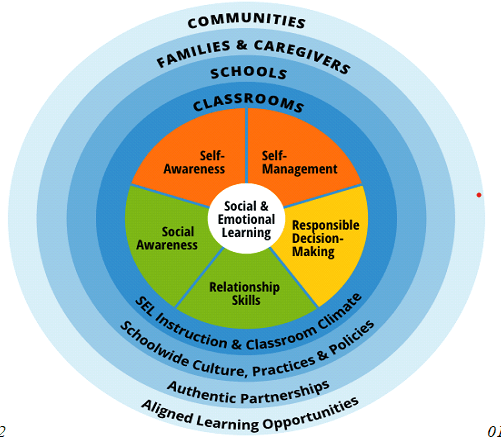
Fostering learners’ social and emotional competence in the classroom might involve a comprehensive strategy. An organised foundation can be established through the introduction of the CASEL (Collaborative for Academic, Social, and Emotional Learning) framework. [Figure 1]. The CASEL framework (2012) states that the approach encompasses valuing students by promoting open communication and active listening and acknowledging the intricate interplay between academic and emotional development.
The interrelated SEL abilities of self-awareness, self-management, social awareness, relational skills, and responsible decision-making are highlighted by the CASEL Framework (CASEL, 2012). Planning, focus, memory, and multitasking are strengthened by these proficiencies, which also improve cognitive, emotional, and behavioural development (Centre on the Developing Child, 2011). Denham et al. (2003) emphasise the significance of early childhood experiences for play, learning, and relationship formation, underscoring the necessity of social and emotional competence for navigating diverse life stages adeptly.
Figure 1 below illustrates the CASEL framework, highlighting the interplay between academic and emotional development.
Incorporating SEL through structured frameworks like CASEL can equip learners not just for academic success, but for lifelong well-being and responsible citizenship. As educators and stakeholders, it is our collective responsibility to nurture these competencies from the early years onward.