


Broken Windows
By Prof. Riddhi Shukla
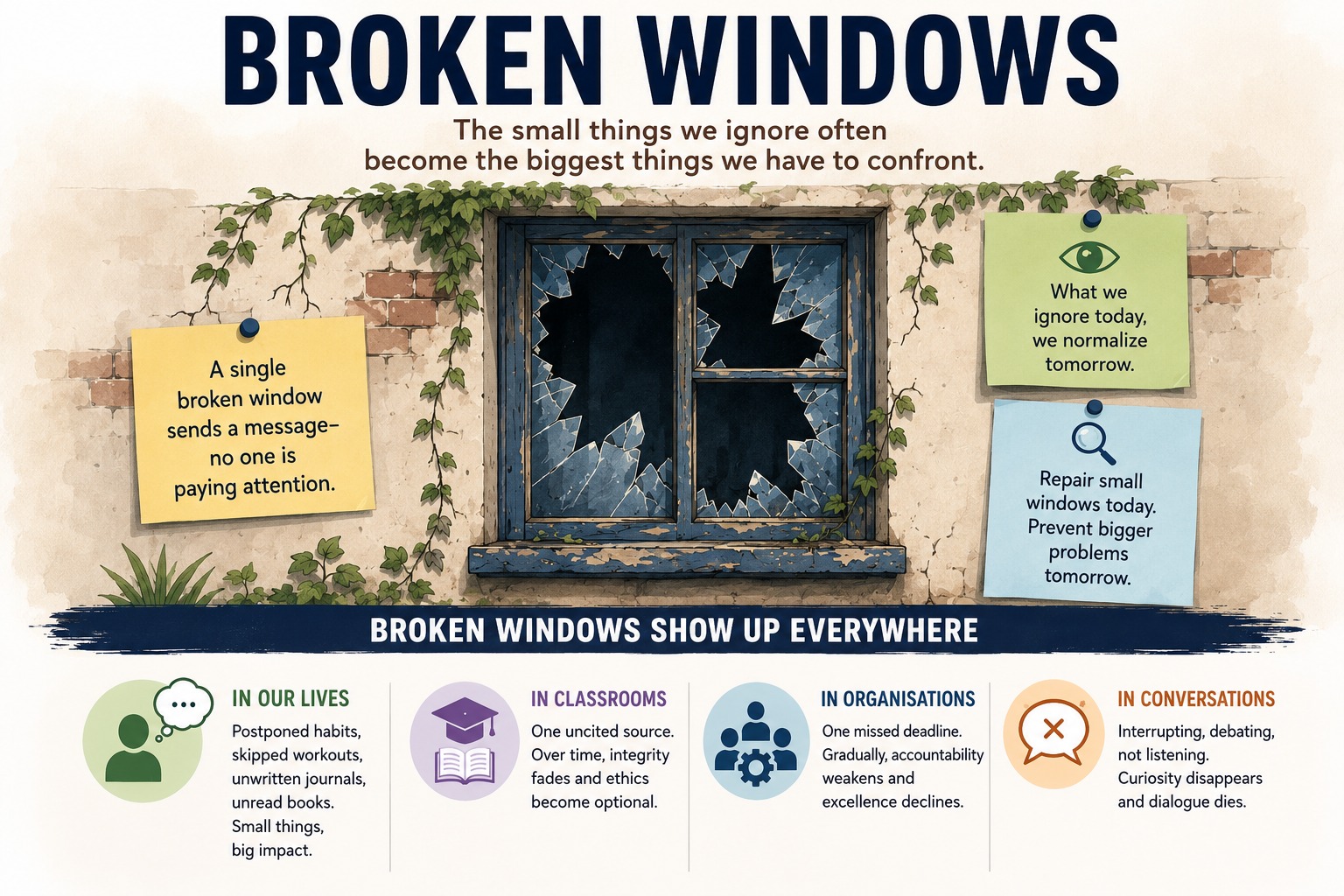
The small things we ignore often become the biggest things we have to confront
As a child, I remember passing through the house on the way to my school, the house that everyone called the “haunted house.” It was not haunted because someone had seen ghosts in it. It looked haunted because no one seemed to care for it. The windows were broken, the paint had faded, weeds had grown around the entrance, and with every passing year, it looked more abandoned. Looking back, I realise that what had frightened me was not the house itself, but what the broken windows represented. They silently announced, “No one lives here. No one cares.”
That childhood memory resurfaced recently while we, the faculty at ITARI, were having a discussion about Broken Windows Theory, developed by James Q. Wilson and George L. Kelling in 1982. The theory proposes that visible signs of disorder and neglect encourage further disorder. A single broken window, if left unrepaired, communicates that no one is paying attention. Soon, more windows are broken, graffiti appears, litter accumulates, and the environment gradually deteriorates. The issue is never the window itself; it is the message the broken window sends.
As I continued reflecting, I found myself moving beyond crime prevention and urban environments. I began wondering whether the theory might also describe our own lives.
Perhaps each one of us has broken windows, not as dramatic failures or life-changing mistakes, but the small visible signs that we repeatedly ignore. For instance, a postponed conversation, a journal left unwritten, or the book we keep saying we will read tomorrow, or the exercise we skip because we are “too busy”, or the reflection which we promise ourselves we will do next week. Individually, they appear insignificant. Together, they quietly shape the direction of our lives. This is exactly how small issues become larger ones.
In a classroom, a student forgets to acknowledge the source of an image in a presentation. It is overlooked because it is only one image. Over time, citations become inconsistent, originality declines, and students begin to see attribution as optional rather than an ethical responsibility. The issue is not the missing citation; it is the gradual erosion of academic integrity.
The same pattern exists in organisations. One missed deadline becomes acceptable. Slowly communication becomes inconsistent, accountability weakens and eventually, projects fail. Not because of one missed deadline, but because small lapses became normal. While the broken window is always small, its consequences rarely are.
As I reflected further, another idea emerged. I began to wonder whether ignored broken windows eventually become blind spots. A broken window is visible. A blind spot is not.
When the same behaviour keeps recurring and we never stop to ask why, the broken window transforms into something deeper. For instance, I might repeatedly postpone deep reading and blame it on a busy schedule. But what if the real issue is not lack of time? What if I am unconsciously avoiding work that demands sustained thinking because it is intellectually uncomfortable?
The broken window is postponing the reading. The blind spot is not recognising what I avoid and why. This distinction changed how I understood the theory. Perhaps broken windows are not simply problems waiting to be fixed. Perhaps they are invitations to become more self-aware.
As educators, we have our own broken windows. Like skipping reflection after a lesson, ignoring current educational research, avoiding difficult conversations with colleagues, or just relying on teaching methods that have become comfortable rather than questioning whether they still serve our learners.
None of these seem alarming on any given day. Yet over time, they quietly influence our professional growth. Excellence rarely declines overnight. It erodes through small acts of neglect that gradually become normal.
This reflection also reminds me of Cal Newport’s Deep Work. One of the greatest broken windows of our time may be our relationship with attention. We check our phones every few minutes. Those notifications constantly interrupt our thinking. We keep multi-tasking throughout the day and eventually silence becomes uncomfortable for us.
At first glance, these seem like harmless habits. Yet they may create one of the greatest blind spots of modern life. We begin to mistake information for wisdom. We assume that because we consume more content, we are thinking more deeply. In reality, our capacity for sustained attention, reflection, and meaningful insight may be slowly declining.
Another broken window I see around us is the decline of genuine dialogue. People interrupt before others have finished speaking. Conversations have now become like debates. Listening becomes waiting for our turn to respond and in a matter of no time, curiosity begins to disappear. As an educator, this concerns me because inquiry cannot flourish where genuine listening has disappeared. The quality of our questions depends on the quality of our attention.
The more I reflect, the more I realise that repairing broken windows has little to do with perfection. It is not about fixing our character flaws or eliminating every weakness. It is about paying attention to the small things we repeatedly ignore before they quietly shape the person we become.
Coming back to the haunted house from my childhood, I realise it did not become abandoned in a single day. It became abandoned because neglect accumulated over time. Every unrepaired window silently invited further neglect.
Our lives are not very different. Every ignored habit, every postponed reflection, every neglected relationship, every avoided conversation sends a message, not only to others, but to us.
The question is no longer whether we have broken windows. The real question is: What small window in my life have I stopped noticing? Because repairing that one window today may prevent a much larger problem tomorrow.
Perhaps personal growth does not begin with dramatic transformations. Perhaps it begins by repairing one broken window at a time.